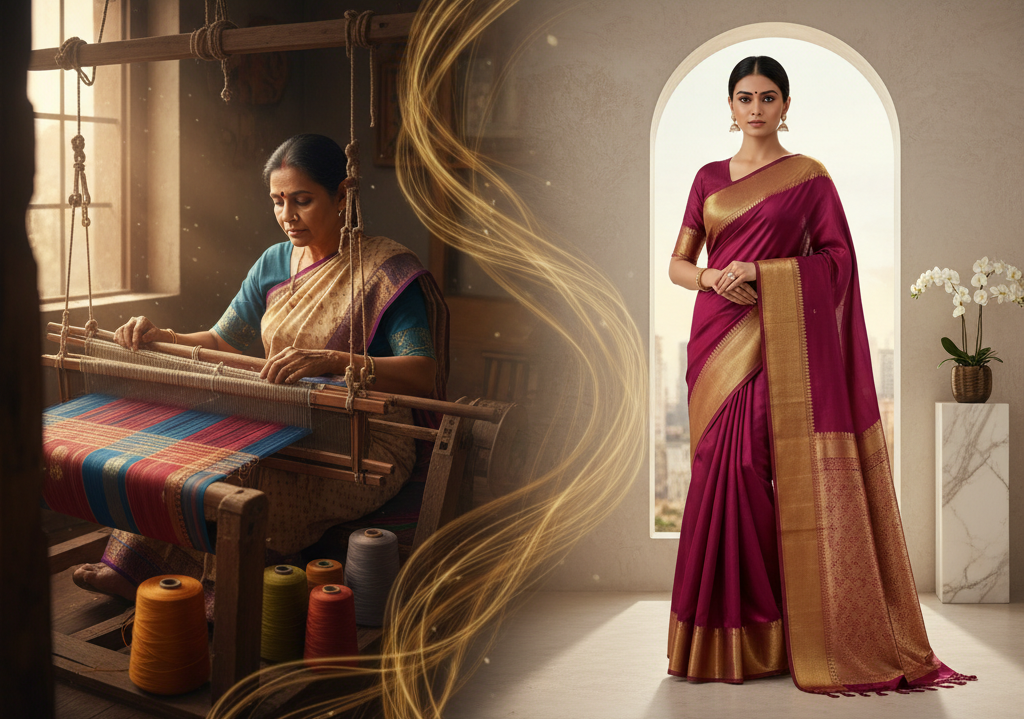
From Loom to Luxury: How a Maheshwari Saree is Made
“Every Maheshwari saree is a story—of threads of devotion, artistry, and heritage that begin on a loom and become a piece of luxury.”
Indian handlooms have always been famous worldwide for their craftsmanship, cultural depth, and elegance. Every region has its own unique weave, and the jewel of Madhya Pradesh’s Maheshwar town is the Maheshwari Saree.
Lightweight, elegant, and timeless, Maheshwari sarees are known for their silk-cotton blend, zari borders, and motifs inspired by Maheshwar’s forts and the Narmada River. But what makes them truly special is the entire process and emotion behind the creation of each one.
Let’s take a step-by-step look at how a Maheshwari saree makes its journey from loom to luxury.
Step 1: The Legacy Begins—Selecting the Threads
The creation of a Maheshwari saree starts with the careful selection of silk and cotton threads.
- Cotton threads make the saree lightweight and breathable.
- Silk threads give it its characteristic shine and luxurious finish.
- Zari (gold/silver thread) adds a royal touch.
These threads are chosen with immense care because the entire saree’s texture and comfort depend on them.
Step 2: Dyeing—A Story of Colors
The next step is yarn dyeing. The threads are dyed using a blend of natural and synthetic dyes.
Traditionally, the shades included pomegranate red, gulbakshi pink, rani magenta, blue, and purple. Today, pastel and contemporary colors are also created for designers.
These colors reflect the soil of Maheshwar, the waters of the Narmada, and the vibes of the temples.
Step 3: The Loom Setup—Where the Magic Begins
To weave a saree on a handloom, the warp (vertical) and weft (horizontal) threads must first be set up.
- Warp (Vertical Threads): The cotton or silk threads stretched on the loom.
- Weft (Horizontal Threads): The zari, silk, or cotton threads used to create the motifs and designs.
Weavers perform this process like a ritual, as for them, it’s not just a piece of fabric—it’s the creation of a piece of heritage.
Step 4: Designing the Borders and Motifs
One of the most distinguishing features of Maheshwari sarees is their borders and motifs.
The motifs are inspired by:
- Eent (brick design): The walls of the fort
- Leheriya (waves): The Narmada River
- Chameli (jasmine): Purity and devotion
- Heera (diamond): Royal prosperity
- Chatai (mat weave): The essence of craftsmanship
The borders are always made in contrasting colors that give the saree a regal look. The most unique feature is the Bugdi border—a reversible border, which means the saree can be worn on both sides.
Step 5: The Weaving—Rhythm of the Loom
This is where the true art begins—the handloom weaving.
- Weavers operate the shuttle with their hands.
- A rhythm is created—the “click-clack” sound that echoes throughout Maheshwar.
- It takes a minimum of 3–7 days to make a single saree, sometimes more.
With every thread, the weaver weaves in their heart, prayers, and dedication.
Step 6: The Finishing Touches
Once the saree is woven, it undergoes the final finishing process.
- The saree is carefully folded and inspected.
- Extra threads are trimmed.
- The borders are polished to give them a final shine.
At this point, it becomes a luxury heirloom piece, ready to find its place in a bride’s trousseau or a collector’s wardrobe.
From Local Looms to Global Luxury
The journey of Maheshwari sarees isn’t limited to Maheshwar.
Today, these sarees have reached fashion weeks, luxury boutiques, and global runways. Brides choose them for their wedding days, fashionistas style them in fusion outfits, and conscious buyers prefer them as a form of sustainable slow fashion.
Wearing a Maheshwari saree means carrying the heritage of a town, the peace of a river, and the legacy of a queen with you.
The journey of a Maheshwari saree from loom to luxury is a story of art, patience, and devotion. What a weaver creates with their hands can never be replicated by a machine.
So, when you wear a Maheshwari saree, you aren’t just wearing an outfit; you’re wearing a centuries-old story, a queen’s legacy, and an artisan’s dream.
Maheshwari sarees truly are—”From Loom to Luxury.”